

When people hear biophilic interior design, they often picture pale walls, light woods and a sea of soft neutrals. Calm. Minimal. Safe. Beige.
It’s a comforting image, but it’s also a misunderstanding. Nature is not neutral.
Walk through a woodland in autumn and you’ll find burnished copper, inky bark, mossy greens and flashes of gold. Stand on a coastline and you’ll see chalky whites, storm blues, kelp greens and the deep charcoal of wet stone. Look closely at a single leaf and you’ll find veining, shadow, translucency and depth.
Biophilic interior design was never meant to reduce homes to oatmeal and oak. At its heart, it is about reconnecting us with the natural world in ways that support wellbeing, emotion and rhythm. Colour is one of the most powerful tools we have to do that.
A beige home can be calming.
But so can forest green.
So can clay red.
So can deep ocean blue.
The difference is not whether colour is used, but how it is understood.
What “natural” really means
In interiors, “natural” has quietly become shorthand for pale, quiet and restrained. Yet the natural world is anything but flat. It is layered, high-contrast, seasonal and alive.
True biophilic interior design does not ask you to live inside a blank canvas. It asks how your home can echo the emotional experience of nature. That might mean the grounded reassurance of earthy reds and warm ochres, the restorative calm of deep greens and shadowed blues, the brightness of sunlit stone, or the drama of dusk tones, bark browns and charcoal greys.
These colours are not decorative trends, but emotional cues. They speak to something ancient in us. They slow us down, energise us, cocoon us or lift us, depending on how they are used.
This is where biophilic design moves beyond aesthetics and into psychology.
Research into colour and wellbeing consistently shows that our environment affects how we feel, focus and rest. Greens reduce visual fatigue. Blues can lower heart rate. Warm earth tones create a sense of safety and grounding. Deeper shades help the nervous system settle, particularly in spaces designed for rest.
Colour, in other words, is not a surface decision. It is part of how a home works.
You can explore some of this thinking through organisations such as Terrapin Bright Green, whose work underpins much of modern biophilic theory, or through academic research into colour and mood from institutions such as University College London.
What matters for your home is this: colour is not about taste alone. It is about how you want to feel.
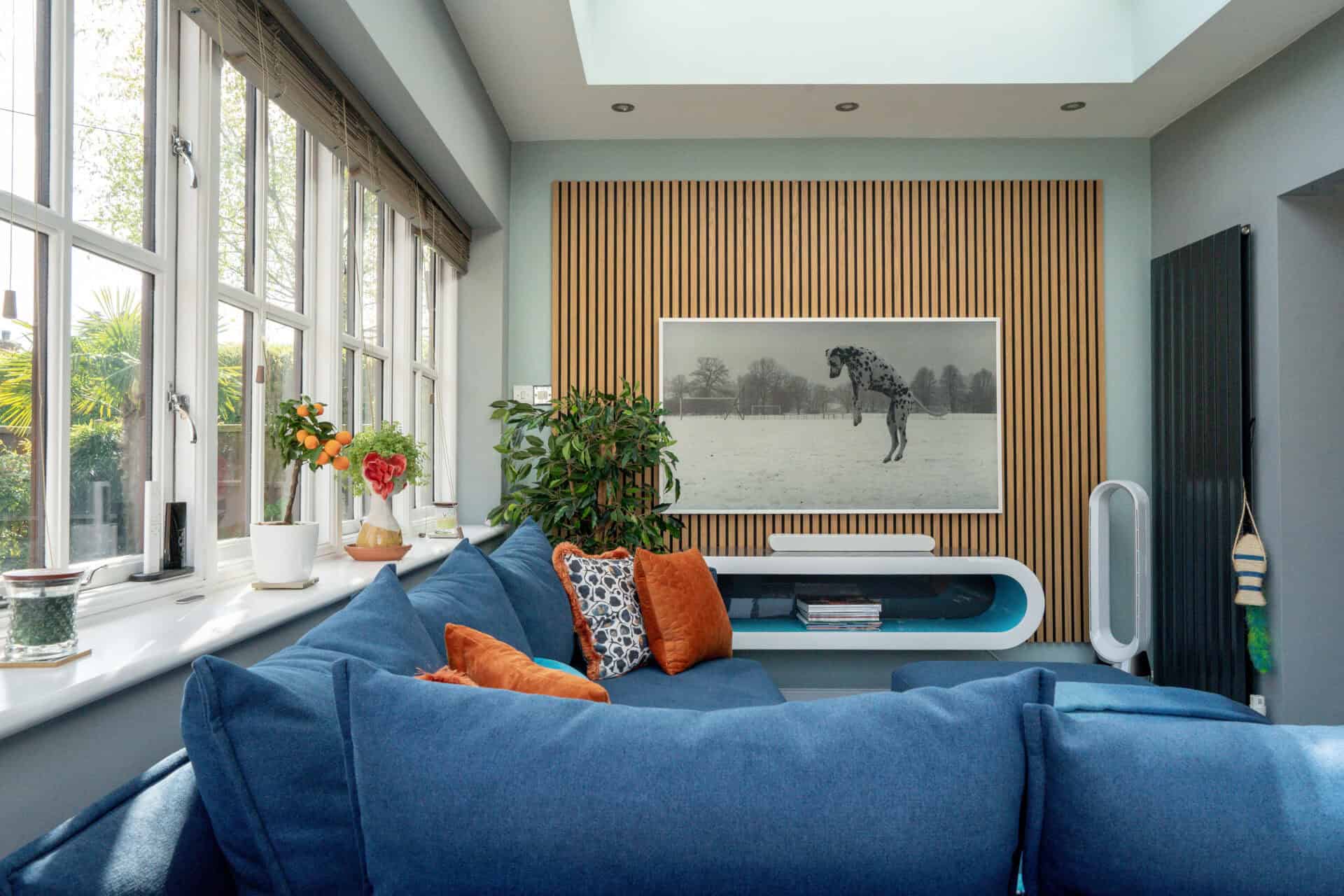
How biophilic colour works in real homes
In practice, biophilic colour is always considered in context.
It responds to natural light, orientation, flow and function. A north-facing snug may benefit from a warm, enveloping tone that counteracts cool light. A south-facing kitchen can carry depth and richness without feeling heavy. An open-plan space can be subtly zoned with colour, creating rhythm and clarity without walls.
In bedrooms, deeper shades often outperform pale ones. Rather than feeling oppressive, they create a sense of retreat. In hallways and transitional spaces, colour can guide movement and establish identity. In living areas, layered neutrals enriched with pigment feel far more natural than flat magnolia ever could.
Biophilic interior design is not about painting everything green. It is about building a palette that mirrors the complexity of the natural world: light and shadow, warmth and coolness, softness and depth.
This is why “choosing colours” at the end of a project so often feels fraught. By that stage, decisions are rushed, light levels are fixed, and opportunities have already been missed.
Colour deserves a seat at the table much earlier.
Why biophilic interior design & colour matters in renovation
In a renovation or new build, early decisions lock in the home’s direction. Layout, glazing, ceiling heights, joinery and lighting all shape how colour will behave long before a paint chart appears.
When colour is treated as an afterthought, homeowners are left trying to decorate their way out of structural compromises. A room feels cold. A space feels flat. A house feels disconnected. The response is often to reach for “safe” neutrals, because they seem low-risk.
Safety is not the same as suitability.
At Rodrigues Interiors, we work with clients before or alongside architects so that colour, light and atmosphere are embedded into the design vision from the outset. This is the purpose of our signature Cornerstone™ process: to create clarity early, while choices are still flexible and budgets are still protected.
It is not about picking paint shades in advance. It is about understanding how you want different spaces to feel, where you need energy and where you need calm, how your home should support daily rhythms, and how light will move through the house across the day.
From there, colour becomes part of the architectural conversation, not a cosmetic layer applied at the end.
This is also why our Interior Strategy Check focuses on clarity. If you do not yet know what you want your home to do for you emotionally, colour will always feel like guesswork.

Beyond trends, towards belonging
Biophilic interior design is often misunderstood as a style. In truth, it is a philosophy. It asks how our homes can help us feel grounded, restored and connected.
Colour plays a central role in that.
Nature is not beige. It is expressive, nuanced and full of contrast. A biophilic home can be quiet or bold, light or moody, restrained or rich. What matters is that it feels coherent, considered and deeply personal.
When colour is used with intent, it does not overwhelm. It anchors. It gives a home identity. It creates places where you want to linger.
This is not about following a palette, it is about designing a life.
If you are planning a renovation and want to understand whether your project has the clarity it needs before serious money is spent, our free Interior Strategy Check will show you where you stand in just a few minutes.
Great homes are not built on beige, they are built on intention.
Find out more about Biophilic Design here.